Guangzhou Port Boosts Speed of Hede Shipping’s US West Coast Express Route
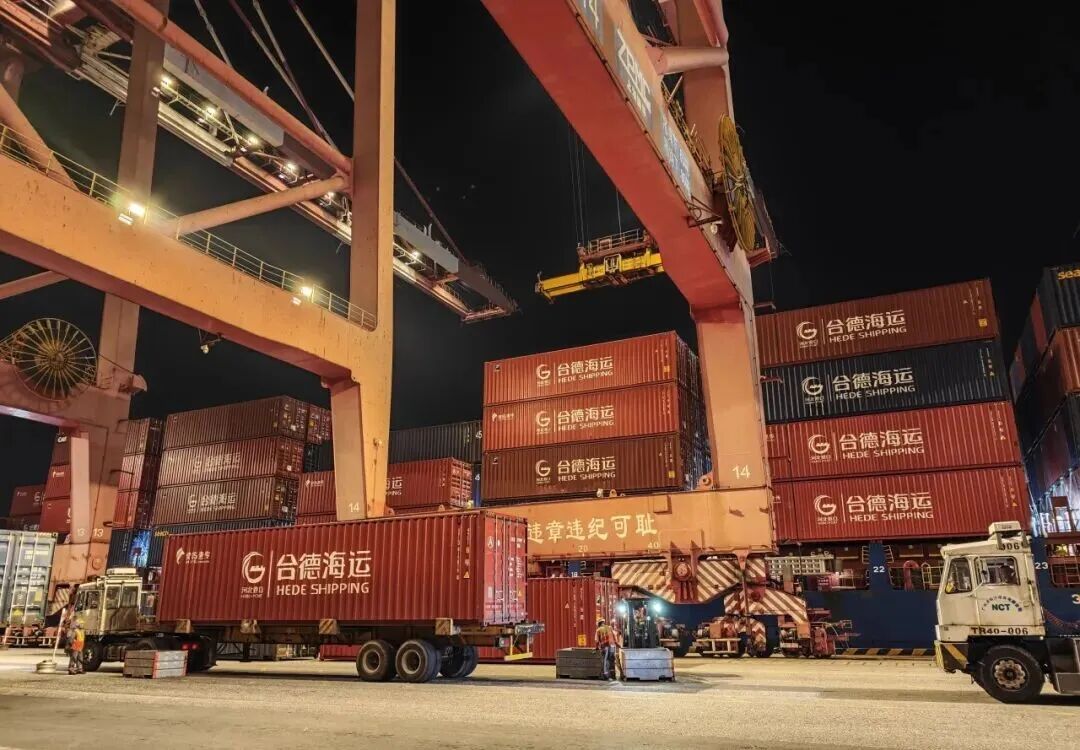
A consignment of 142 40-foot high-cube containers of international transshipment cargo, shipped from Jakarta, Indonesia to Los Angeles, USA, recently moved through Guangzhou Port's Nansha Port Area in a seamless, high-efficiency transfer — a fresh demonstration of Nansha's strength as an international shipping hub.
The cargo moved on the South China–U.S. West Coast Express operated by Hede Shipping. On May 6 the “M.KEPLER” sailed from Jakarta and berthed at Guangzhou Port's Nansha Phase I Terminal in the early hours of May 12. To deliver the "fast-in, fast-out, zero-delay" handling promised for this transshipment, Nansha planned ahead, pre-assigning berths and operational resources to enable direct berthing and immediate cargo work. In parallel, Nansha's port-of-entry agencies — Customs, the Maritime Safety Administration, Frontier Inspection Station, the Port Authority and others — streamlined clearance for international transshipment cargo and opened a priority joint-inspection channel, providing facilitated regulatory support for rapid release and ensuring smooth coordination between port-of-entry agencies, the port operator and the shipowner.
In the early hours of May 13, the “HELGOLAND” sailed from Nansha on schedule, fully loaded, and is expected to berth in Los Angeles on May 27. The end-to-end transit from Jakarta loading to Los Angeles berthing takes just 21 days, offering customers a highly competitive cross-border logistics solution.
The smooth completion of this international transshipment is a clear illustration of Nansha's integrated service capability. Backed by a dense global route network, well-developed terminal facilities, an efficient port business environment and close collaboration with shipping lines, Nansha is steadily expanding its reach and service efficiency as a key international transshipment hub in South China. Guangzhou Port and Hede Shipping have together built international transshipment services connecting major ports in Vietnam, Thailand, Indonesia and other markets to the U.S. West Coast, forging a stable, fast Asia-Pacific maritime corridor.(Picture & Text | Zhou Zhihao)
News
- A National Key Project — Full-scale Construction Begins on Guangzhou Port's Nansha Phase V
- Three Terminals at Guangzhou Port’s Nansha Automobile Port Pass On-Site Assessment for Four-Star “China Green Port” Rating
- Guangzhou Port's Nansha Port Area Launches New Southeast Asia Route, Boosting the "Thailand-South China" Trade Corridor
- Guangzhou Port Group Visits Hebei and Tianjin for Strategic Exchanges, Strengthening North-South Port-Shipping Collaboration to Support the New Dev...
- Guangzhou Port Group Holds 2026 Digital Development Conference Empowering a Global First-Class Shipping Hub with Digital Intelligence