Guangzhou Port Becomes the World's First Port with Full Green Methanol Bunkering Coverage Across Ship Types
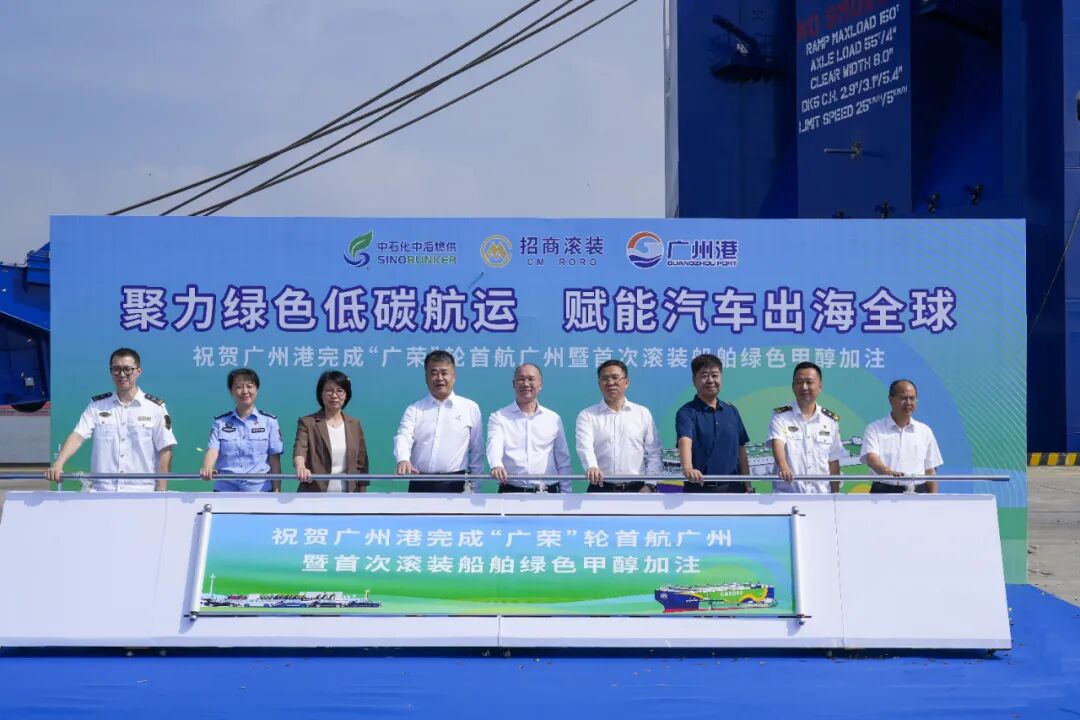
Guangdong Province's first green methanol bunkering operation for a ro-ro vessel was recently completed at Guangzhou Port's Nansha Automobile Port of Entry, under the guidance of the Guangzhou Municipal Bureau of Commerce and the Guangzhou Port Authority and with the coordinated support of customs, border inspection, maritime safety and pilotage agencies at the port. After taking on 2,300 tonnes of methanol — 1,400 tonnes of it bonded green methanol — China Merchants Ro-Ro's newly launched CM GUANGZHOU loaded more than 4,000 new energy vehicles bound for Europe and set out on its maiden voyage from Nansha. The operation marks a key step for the Nansha Automobile Port of Entry in upgrading green, low-carbon shipping services and building global corridors for Chinese vehicle exports. It also makes Guangzhou Port the first in the world able to bunker across all its waters, at anchorage and at berth alike, and the first to cover all three vessel types — container ships, bulk carriers and car carriers — for green methanol bunkering, demonstrating a service capability that spans every scenario and ship type.
The CM GUANGZHOU is a new-generation large green car carrier and the first methanol dual-fuel ro-ro vessel to call at the Nansha Automobile Port of Entry. It has an overall length of 199.9 meters, a molded breadth of 37.7 meters and a design capacity of 7,800 car equivalent units (CEU). Its methanol dual-fuel propulsion system sharply reduces emissions of sulfur oxides, nitrogen oxides and particulate matter, and represents an important technical direction for the green transition of car carriers. On this sailing, the vessel will call at ports in Spain, Belgium and other countries along its Europe route.
With ro-ro shipping space currently in short supply, the Municipal Bureau of Commerce has worked actively with shipping lines to open up more routes and add capacity, making every effort to meet the city's automobile export needs. Automobile exports, the Bureau said, are a key lever for Guangzhou as it builds a high-standard opening-up landscape and works to keep foreign trade stable in scale and better in structure. From January to August this year, the city's automobile exports were worth more than 20 billion yuan, up almost 60% year on year. Guangzhou is now accelerating work on the Guangzhou International Automobile Trade Center and concentrating its efforts on building a modern automobile shipping hub. It will continue to strengthen coordination among ports, industry and trade, keep improving supporting systems, match exporters' needs precisely, open up logistics corridors for vehicle exports, and use high-quality port and shipping services to help Guangzhou's automobile industry set sail for overseas markets.
Guangzhou Port's automobile exports have grown strongly so far this year and are on course to challenge the one-million-vehicle mark for the full year. Exports through the Nansha Automobile Port of Entry rose by 40.9% year on year, while those on the Nansha-Europe route rose by 240% year on year, steadily widening the deep-sea corridor for Chinese vehicle exports. As one of the best-equipped coastal ports in China for clean energy bunkering, Guangzhou Port now has a bunkering service system covering LNG, green methanol and biofuels, and continues to broaden its international shipping services. In April this year, the three terminals at the Nansha Automobile Port of Entry passed the on-site review for four-star Green Port certification from the China Ports & Harbours Association. While the CM GUANGZHOU was alongside, green methanol bunkering and the loading of new energy vehicles went on at the same time — a clear illustration of how green ships and green ports reinforce one another, and a living example of automobile foreign trade and low-carbon shipping developing together in South China.(Text | Yang Anning, Luo Jiahui Photo | Harbour Media)
News
- Guangzhou Port Sinotrans Automotive Supply Chain Co., Ltd. Unveiled in Nansha
- Guangzhou Port Attends the Roundtable of the Silk Road Maritime International Cooperation Forum
- Asia-Pacific Media Delegation Visits Guangzhou Port's Nansha Port Area, Experiencing the Openness and Dynamism of the Smart Mega Port
- Guangzhou Port's Nansha International General Terminal Releases Over 12 Million Aquatic Juveniles in Stock Enhancement Program
- Guangzhou Port Co., Ltd. and China Classification Society Guangzhou Branch Sign Strategic Cooperation Framework Agreement