Guangzhou Port's Nansha Phase IV Fully Automated Terminal Begins Foreign Trade Container Operations
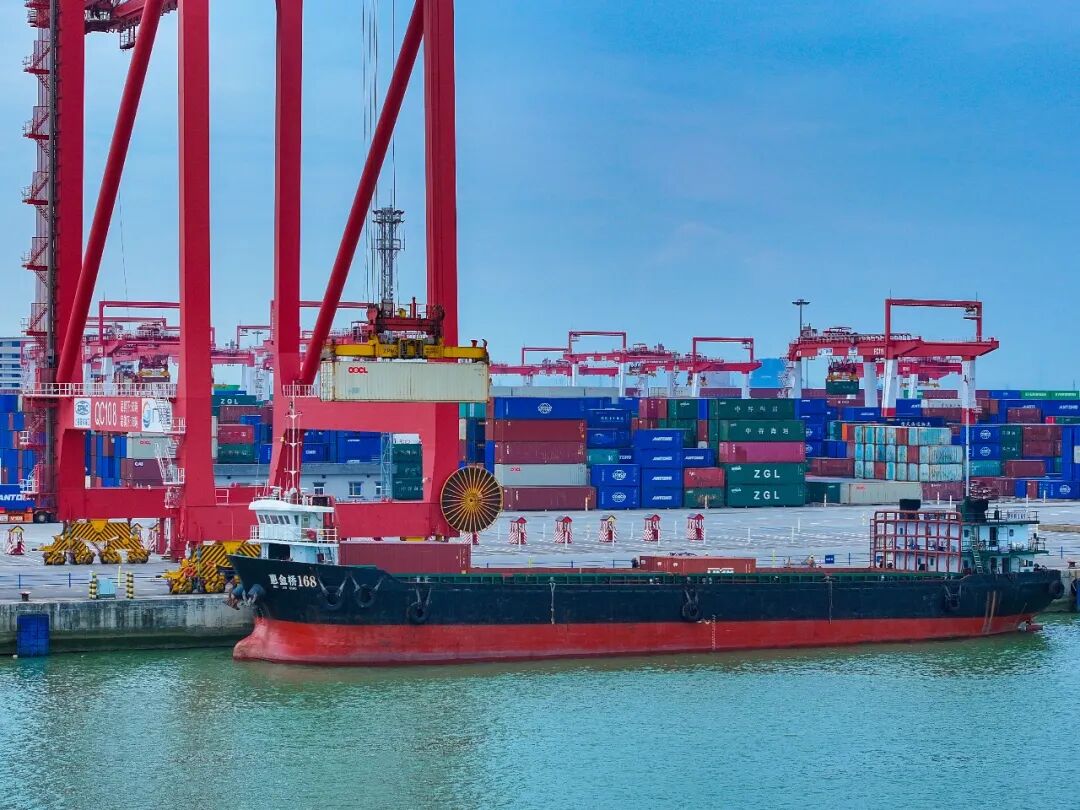
On October 29, with strong support and guidance from customs, the maritime safety administration, border inspection, the commerce bureau, the port authority, the Nansha District government and other agencies, Nansha Phase IV formally began foreign trade vessels operations. This marks a substantive step forward in foreign trade operations for the first purpose-built fully automated terminal in the Guangdong-Hong Kong-Macao Greater Bay Area, showing the exemplary erformance of a new generation of smart ports and injecting fresh momentum to the building of a world-class port cluster in the Greater Bay Area.
Foreign trade business at the Nansha Port Area has grown steadily this year, with foreign trade container throughput up 19% year on year from January to September. The port area now runs 220 container liner services, 185 of them on foreign trade routes — a route network that keeps improving and extends the port's reach further afield.
To keep foreign trade vessel operations running smoothly and cargo moving quickly through customs, Guangzhou Port Group stepped up contact with shipping lines, inspection agencies and other organizations at the port of entry, holding several rounds of detailed discussions. The Nansha Phase IV operations team planned every stage well in advance. Working from how the automated terminal actually runs, and with the particular demands of foreign trade vessels in mind, the team mapped out the key stages along the import and export line, refined each core procedure and streamlined the customs clearance process end to end. The technical team concentrated on port-of-entry supervision requirements, running joint commissioning and stress tests on the automated equipment to confirm that systems and machinery would perform reliably. Departments across Nansha Phase IV worked in close coordination on safety and environmental supervision, overall staff deployment and service support, to ensure that foreign trade business proceeded smoothly and in an orderly manner.
Handling equipment operators have moved from the quayside to an intelligent control center, where technologies, such as automatic anti-sway and anti-skew control, vessel profile scanning, intelligent container landing and OCR recognition, let them pick up containers with precision. An automated information system links the quay cranes seamlessly with the intelligent guided vehicles (IGVs) for efficient interaction. Using intelligent algorithms and the BeiDou navigation satellite system, the IGVs plan their own optimal routes and move containers swiftly to the right part of the yard, where automated rail-mounted gantry cranes place them in the stack with pinpoint accuracy. The system also generates an optimal work sequence automatically from the vessel's stowage plan and the live status of the yard, sharply cutting idle running and waiting time for equipment and turning "smart" technology into efficiency gains that are plain to see.
The efficient, trouble-free completion of this operation confirms that Nansha Phase IV is now formally capable of handling foreign trade vessels. It consolidates and raises the Nansha Port Area's comprehensive foreign trade service capability, and gives exporters in the hinterland firmer support in reaching overseas markets. Guangzhou Port Group will build on this, deepening cooperation with global shipping companies, working with all parties at the port of entry to keep improving customs clearance services, and raising the service capability of Guangzhou as an international shipping hub — taking the initiative and playing a bigger role in driving foreign trade growth in the Greater Bay Area and in supporting efforts to foster a new development paradigm.(Text | Qiu Yaohua, Chen Deze)
News
- Nansha Phase III of Guangzhou Port Puts 20 More Battery-Electric Terminal Tractors into Service
- Guangzhou Port Becomes the World's First Port with Full Green Methanol Bunkering Coverage Across Ship Types
- Guangzhou Port Sinotrans Automotive Supply Chain Co., Ltd. Unveiled in Nansha
- Guangzhou Port Attends the Roundtable of the Silk Road Maritime International Cooperation Forum
- Asia-Pacific Media Delegation Visits Guangzhou Port's Nansha Port Area, Experiencing the Openness and Dynamism of the Smart Mega Port