Freedom to Enjoy Cherries Takes Another Step Forward! First Shipment of 8,000 Tons of Chilean Cherries Arrives at Nansha Port
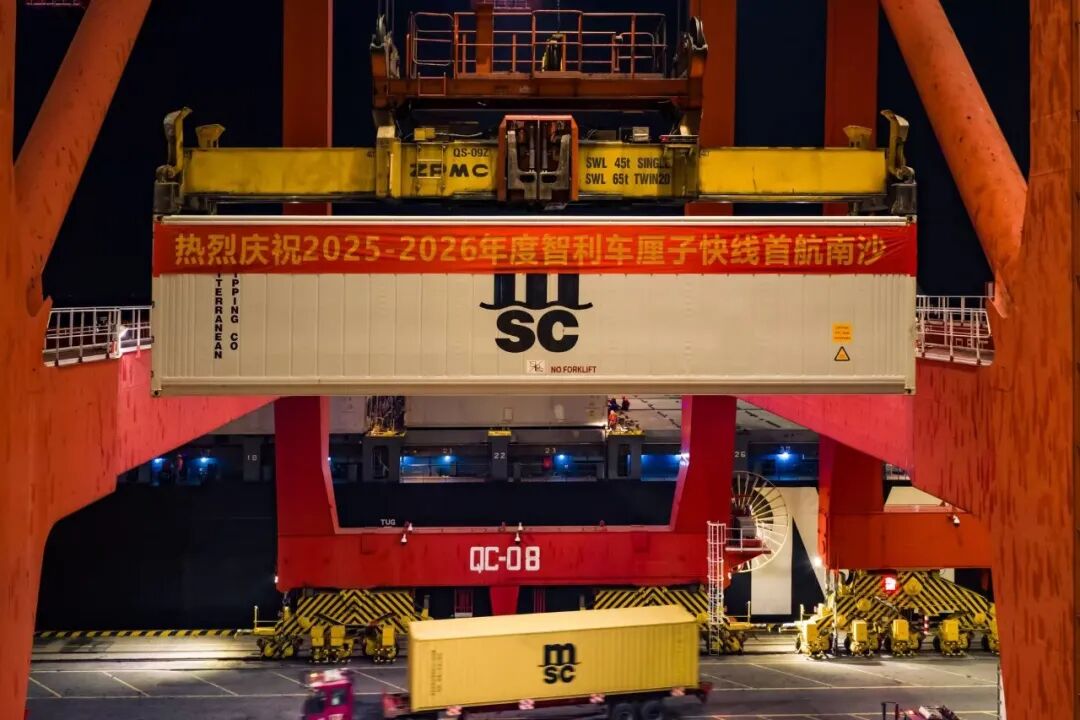
At 00:00 a.m. on December 6, approximately 370 containers (around 8,000 tons) of cherries from Chile, carried by the “MSC LOME V” on its maiden voyage from the Mediterranean Shipping Company’s South American Alpaca express route, smoothly docked at Nansha Phase III Terminal of Guangzhou Port. This not only marks the official opening of the 2025-2026 Chilean cherry season but also signifies the inaugural voyage of the Mediterranean Shipping Company’s Alpaca South America-Nansha route, further strengthening the economic and trade network between the Guangdong-Hong Kong-Macao Greater Bay Area and Latin America.
According to industry forecasts, Chile’s cherry exports to China this season are expected to reach a new record high, with the vast majority to be shipped by sea. The first shipment arrived one week earlier than the previous season, featuring the highly popular varieties “Lapins” and “Santina”. Thanks to an extended trading window period, this year’s cherry peak season is likely to last longer than in previous years.
It is predicted that before the Spring Festival, Nansha Port Area will handle 19 vessels carrying over 10,000 containers (approximately 200,000 tons) of Chilean cherries, accounting for about one-third of the national total imports. As a microcosm of the continuously expanding shipping network connected to the South American, Guangzhou Port has seized the opportunities arising from the development of China-Latin America economic and trade relations, operating Chilean cherry express services for seven consecutive years since 2019. To date, the port has unloaded approximately 500,000 tons of cherries, making it one of the largest cherry import hubs in China.
The “MSC LOME V” on its maiden voyage departed directly from the Port of San Antonio in Chile to Guangzhou Nansha Port. The “Alpaca” route, to which it belongs, is a dedicated express service launched by Mediterranean Shipping Company to meet the peak demand for the export of fresh agricultural products such as cherries. The route significantly reduces traditional transit time, establishing an efficient “maritime expressway”.
In April this year, Guangzhou Port expanded its direct WSA3 route to the west coast of South America. The newly added “Alpaca” route not only facilitates premium tropical fruits from Latin America, seafood from the Pacific coast, wines from the Andes region, as well as goods like pulp, fishmeal, and minerals to enter the Greater Bay Area market, but also opens up a maritime corridor for “Made in China” products such as home appliances, electronics, and furniture to reach South America.
To ensure this batch of fresh delicacies from 20,000 kilometers away reaches the market with the utmost speed and optimal quality, Guangzhou Port has collaborated with various port authorities to establish a comprehensive, high-efficiency “express logistics channel”. Based on an in-depth review of past experiences, Nansha Phase III Terminal has comprehensively optimized its operational processes and services. Through system upgrades and resource coordination, seamless integration has been achieved across all processes from vessel unloading and yard positioning to inspection and container pickup, significantly enhancing operational efficiency. Manager Li of the Operations Department of Guangzhou Port Nansha Container Phase III Terminal stated, “For this operation, we have specifically developed a detailed operational plan, which includes pre-planning gates and trailer scheduling, setting up two ‘dedicated cherry lanes’, optimizing traffic flow both inside and outside the port area, and pre-simulating each step in advance, so as to ensure smooth logistics during peak periods.”
Benefiting from the Work Plan of Guangzhou City on Enhancing Customs Clearance Facilitation issued earlier this year and a series of pioneering reforms, Nansha Port has established a well-developed customs clearance support system for fresh goods. By combining facilitation measures such as “advance declaration”, “direct shipside pickup” and “conditional release”, the customs authorities have achieved “inspection upon arrival and swift clearance”. Border inspection, maritime affairs, port authorities and other departments have made coordinated efforts to ensure “direct entry and berthing” for vessels. This efficient process enables cherries to be transported from unloading to local wholesale markets in as little as two hours, setting a remarkable “Nansha speed” for customs clearance of fresh produce.
“To effectively oversee the customs clearance of cherries, we actively gathered information on enterprises’ chartered vessel arrival plans and guided them to make full use of facilitation measures such as ‘conditional release’, ensuring the safe and efficient customs clearance of imported cherries,” stated Yang Fajia, Deputy Section Chief of the Cold Chain Supervision Section of Nansha Port Phase III of Nansha Customs, “Based on the declarations from enterprises, nearly 1,000 containers of Chilean cherries are expected to arrive weekly during the peak season”.
Leveraging its proximity to the port, Nansha Port Area has developed comprehensive facilities, including one of Asia’s largest cold chain logistics bases, which are equipped with multiple functions, such as inspection, storage, sorting, trading, transportation, and distribution. The port area has further refined its operational zones by adding specialized areas for inspection, simple processing, sorting, packaging, and distribution. Through specialized temperature-controlled zones and an intelligent logistics system, it ensures full-chain temperature control from customs inspection upon arrival to warehouse operations. By capitalizing on the geographical synergy between the Jiangnan Fruit Wholesale Market and Nansha Port Area, a fast “inspection-release-transportation” channel has been established to ensure the efficient flow of cherries from the port to the market. Upon arrival, cold chain goods can not only quickly enter the domestic market but also undergo value-added sorting and repackaging. Through a well-developed “port + railway” multimodal transport network, the goods are efficiently distributed to markets across the country.
Guangzhou Port is undergoing a transformative leap from a traditional port operator to a port-based integrated logistics service provider and an innovation-driven port. Taking cherry imports as an example, Nansha Port Area is continuously expanding its global fresh produce supply chain system. In the future, more high-quality agricultural products will enter China through this efficient channel, while Chinese manufactured goods and consumer vitality will also flow more smoothly to the rest of the world, truly realizing the vision of “buying globally and selling globally”.(Text | Cao Chang, Xiao Wentao, He Jiali, and Yan Yonghong Picture | Port Propaganda Department, Port Media)
News
- Guangzhou Port Co., Ltd. Signs Strategic Cooperation Framework Agreement with Ansteel Lianzhong and SITC International
- Inaugural Run of "Nansha Port - Ganzhou International Port" Sea-Rail Intermodal Cold Chain Train
- Guangzhou Port Co., Ltd. Becomes Guangdong's First Bonded Trading Warehouse for Soybeans in the Offshore Spot Market
- Guangzhou Port Co., Ltd. and China Certification & Inspection Group Guangdong Sign Strategic Cooperation Agreement
- Huang Bo Attends the Convention between Carriers and Ports for Ocean Alliance 2026 and Delivers a Keynote Speech