Innovative Chongqing-Guangzhou Sea-Rail Intermodal Transport Model Empowers “Chongqing-made Vehicles Going Global”
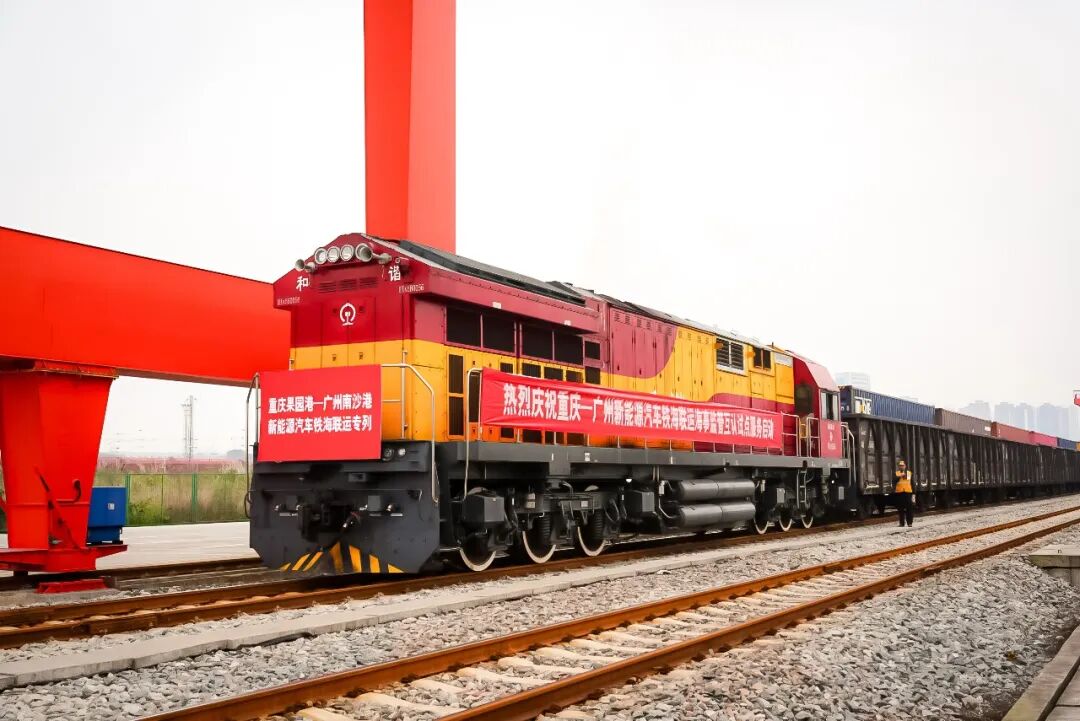
In active response to the national Belt and Road Initiative and the dual-circulation development strategy, government departments in Chongqing and Guangdong have joined hands to promote innovation in regional collaborative development mechanisms, and jointly launched a pilot service for mutual recognition of maritime supervision for new energy vehicles in the Chongqing-Guangzhou sea-rail intermodal transport corridor recently.
Recently, the first batch of Chongqing-made new energy vehicles under the model of mutual recognition of maritime supervision departed from Chongqing and arrived at Nansha Port South Station via the Chongqing-Guangzhou sea-rail intermodal transport corridor. This shipment, comprising 108 new energy vehicles loaded in 36 forty-foot containers with a total value exceeding RMB 10 million, will be loaded at the Phase III Terminal of Guangzhou Nansha Port for export to the Middle East. This pilot service marks the entry of Chongqing and Guangzhou ports into a new stage of collaborative supervision featured by “mutual recognition of supervision and one-time clearance”, injecting strong momentum into promoting the integration of land-sea resources and deepening regional development coordination.
For a long time, new energy vehicles have faced regulatory challenges in sea-rail intermodal transport: railway transport treats them as ordinary cargo, while maritime transport classifies them as Class 9 dangerous goods. Under the traditional model, companies are required to complete procedures such as maritime supervision and declaration only after the goods arrive at the port of exit. This process not only extends customs clearance cycles and increases logistics costs but also raises the risk of cargo damage. As an important automotive industry base in western China, Chongqing is experiencing growing demand for new energy vehicle exports, so that addressing the regulatory barriers in sea-rail intermodal transport has become an urgent issue to resolve.
At the end of 2025, through the joint efforts of multiple departments from Chongqing and Guangdong, including Chongqing Port and Logistics Office, Guangdong Provincial Department of Commerce, Guangzhou Municipal Commerce Bureau, Chongqing Maritime Safety Administration, Guangdong Maritime Safety Administration, Guangzhou Maritime Safety Administration, and Nansha Maritime Office, the Chongqing-Guangzhou Corridor innovatively established a maritime supervision service model for sea-rail intermodal transport of new energy vehicles featured by “container inspection at the loading site and ship inspection at the loading port”. The core of this model is to move the maritime inspection procedure that should have been carried out at the port of exit to the place of departure. Before the shipment of this batch of goods, inspectors from the Chongqing Maritime Safety Administration visited the company’s warehouse to supervise and guide the entire loading process, while the company completed the cargo declaration in Chongqing simultaneously. After the goods arrived at Guangzhou Nansha Port, they could directly proceed to the maritime shipping process without repeated inspections by coastal maritime authorities, truly achieving the seamless end-to-end service of “one-time authorization, and one document for the entire process without repeated container inspections”.
With the full support and close collaboration of railway departments such as China Railway Chengdu Group and China Railway Guangzhou Group, this dedicated sea-rail intermodal transport service for new energy vehicles arrived at Guangzhou Nansha Port just 48 hours after departing from Chongqing. Guangzhou Port coordinated with Volta Shipping to secure container availability and maritime shipping space. The improved efficiency has not only enhanced the stability and predictability of the Chongqing-Guangzhou sea-rail intermodal logistics corridor but has also delivered tangible economic benefits to enterprises.
The successful implementation of this pilot project of mutual recognition of maritime supervision represents an innovative initiative by government departments in Chongqing and Guangdong to actively respond to the national strategy for coordinated regional development and deepen reforms in streamlining administration, delegating power, and improving services. It will significantly facilitate cross-border trade between the two regions and optimize the international business environment in inland areas. As a key node in this mutual recognition of maritime supervision, Guangzhou Port has anchored itself to the development strategy of “hub + corridor + network”, continuously deepened its presence in the inland hinterland of Chengdu and Chongqing, and strengthened its port hub capabilities, and provided customers with end-to-end international logistics solutions in recent years. As an efficient corridor between the inland Chengdu-Chongqing region and global markets, the Chongqing-Guangzhou sea-rail intermodal corridor, it handled a container throughput of 22,000 TEUs in 2025, achieving a year-on-year growth of 190%. Currently, the corridor operates with 4 scheduled departures every week, maintaining a stable railway transit time within 48 hours.(Text by Fang Kun Picture by the Logistics Company)
News
- Guangzhou Port Co., Ltd. Signs Strategic Cooperation Framework Agreement with Ansteel Lianzhong and SITC International
- Inaugural Run of "Nansha Port - Ganzhou International Port" Sea-Rail Intermodal Cold Chain Train
- Guangzhou Port Co., Ltd. Becomes Guangdong's First Bonded Trading Warehouse for Soybeans in the Offshore Spot Market
- Guangzhou Port Co., Ltd. and China Certification & Inspection Group Guangdong Sign Strategic Cooperation Agreement
- Huang Bo Attends the Convention between Carriers and Ports for Ocean Alliance 2026 and Delivers a Keynote Speech